

Overview
The Insight Tree is Memind’s long-term understanding layer. Most memory systems help an agent remember fragments. They extract facts, store them, and retrieve them later. Some systems add summaries or insights, but those insights are often one-time or periodic summaries over a batch of memory. Memind treats insight differently. The Insight Tree is not a summarization feature. It is a continuously evolving memory structure that helps an agent carry forward what it has learned. A flat memory store makes the agent search the past. The Insight Tree lets the agent preserve accumulated understanding: what the user consistently prefers, what the agent has learned to do, which patterns are stable, and which assumptions are changing.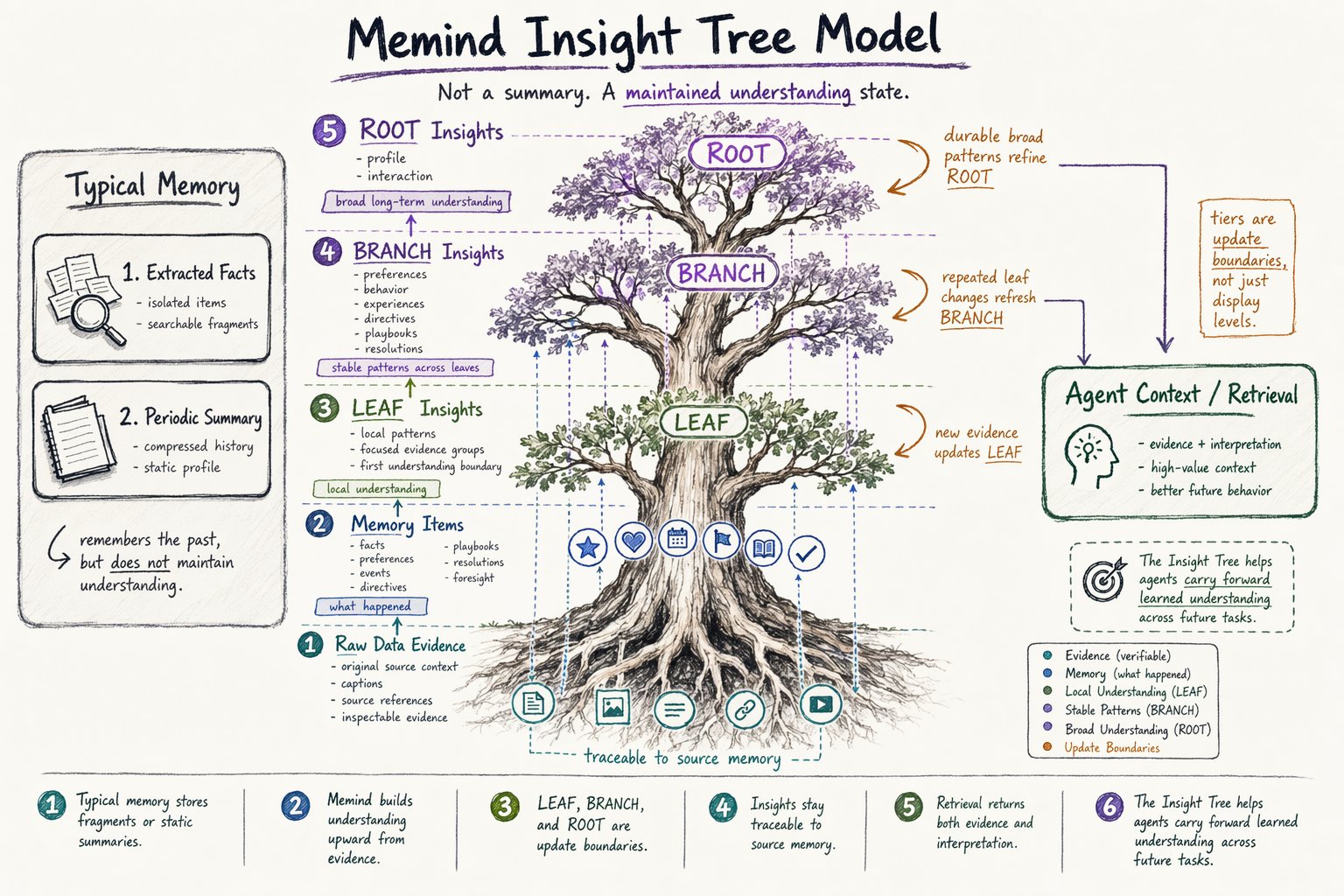
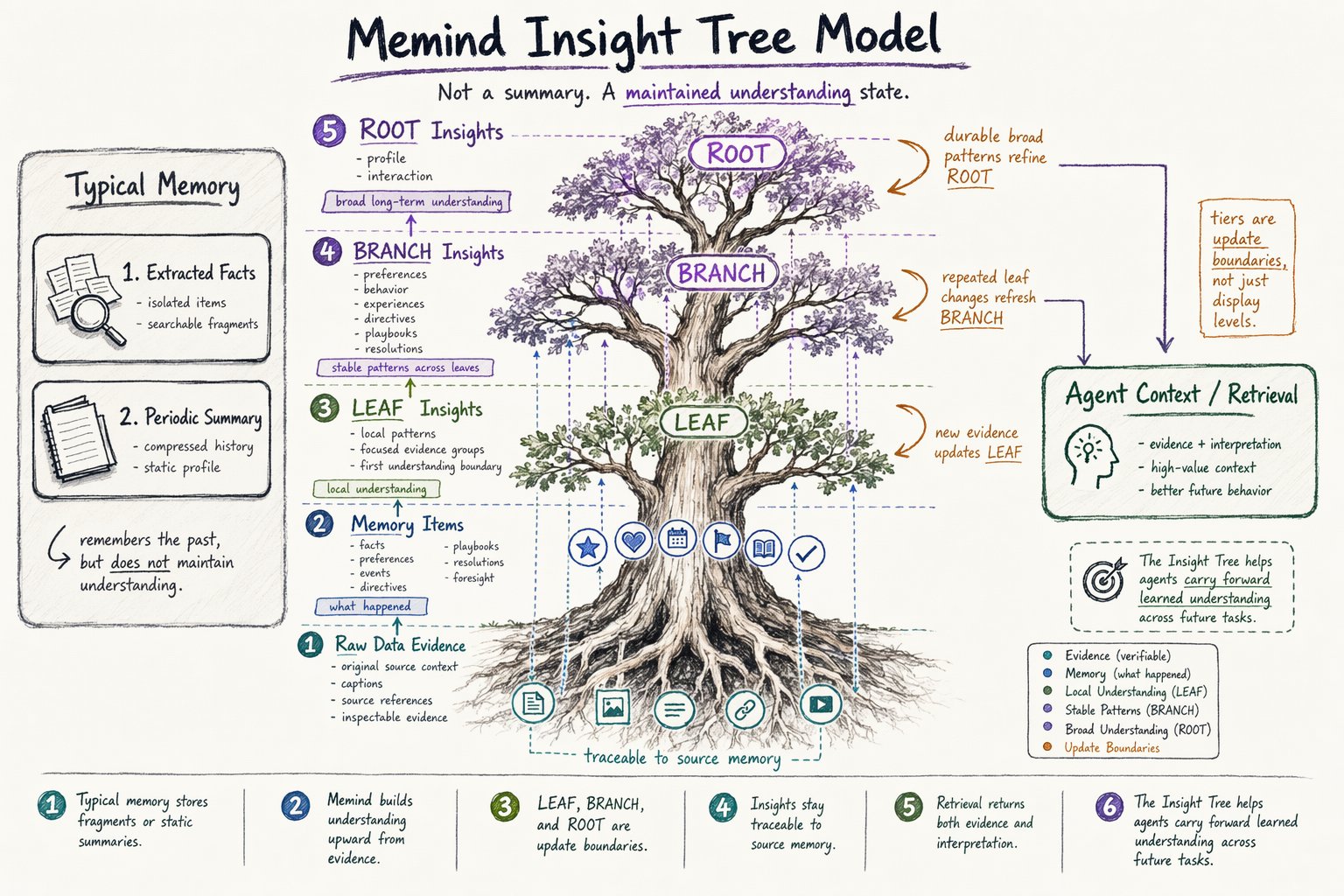
Memory Items remember what happened.
The Insight Tree learns what those memories mean.
What Memind adds beyond memory summaries
The Insight Tree is built on mechanisms that make it different from a simple summary layer.
This makes the Insight Tree a maintained understanding state, not a periodic compression job.
Why memory summaries are not enough
Flat memory can store useful facts:- the user uses Java 21
- the user prefers stable tools
- the user is preparing a release
- the user cares about clear documentation
- the user may build a SaaS version later
The user is working on documentation and prefers clear technical explanations.That is better than isolated facts, but it is still limited. A summary compresses history. It does not necessarily maintain a structured understanding model. It may not know which evidence supports the insight, how the insight should change when new memory arrives, or how a local observation should affect broader understanding. For long-running agents, the harder problem is not generating an insight once. The harder problem is maintaining and evolving understanding over time. Memind’s Insight Tree is built for that long-running process.
Same memory, different understanding
Imagine a user says these things across several sessions:- “I usually use Java 21 for backend projects.”
- “I prefer stable libraries over experimental ones.”
- “I want the documentation to explain why Memind is different.”
- “This sounds too generic. It should be grounded in implementation.”
- “Later we may need to separate open-source docs from a SaaS version.”
- “Show me the architecture and processing logic, not only marketing claims.”
A summary-based system may produce:
The user is working on Memind documentation and prefers clear technical content.Memind’s Insight Tree can build layered understanding instead:
The difference is not only that Memind can produce a better paragraph.
The difference is that Memind gives the agent a reusable interpretation layer. The next task does not start from scattered retrieved facts. It starts from what the system has already learned.
How this improves agent behavior
The Insight Tree changes what retrieval can return. Without an understanding layer, retrieval mostly returns fragments: individual facts, snippets, or past messages. The agent then has to infer the larger pattern during every task. With the Insight Tree, retrieval can return both evidence and interpretation.
Suppose an agent is asked:
Write the next section of the Memind docs.A flat memory system may retrieve:
- the user dislikes generic descriptions
- the user wants implementation details
- the user is preparing Memind 0.2.0 docs
The user prefers developer-facing documentation that explains product differentiation through architecture, implementation behavior, and concrete tradeoffs.This changes the agent’s behavior before it writes. It can avoid generic claims, choose architecture-backed explanations, include comparisons only when they clarify the product, and preserve the user’s preferred technical bar across future sessions. The agent receives not only what happened, but what Memind has learned from what happened.
How the tree is built
The Insight Tree is built from eligible memory items. Memind routes memory into insight buffers, groups related evidence, creates or updates leaf insights, and then propagates meaningful changes upward into branch and root insights.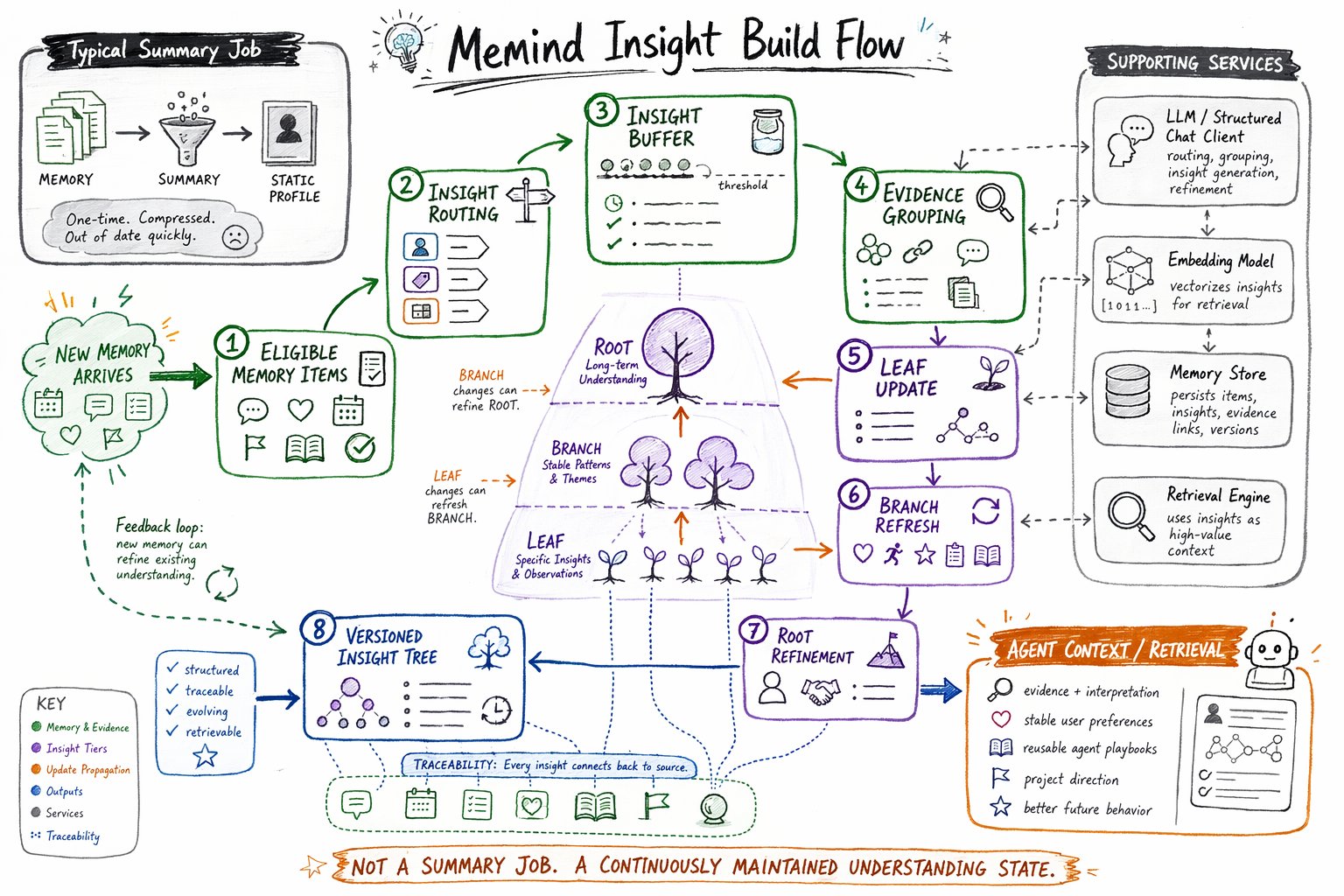
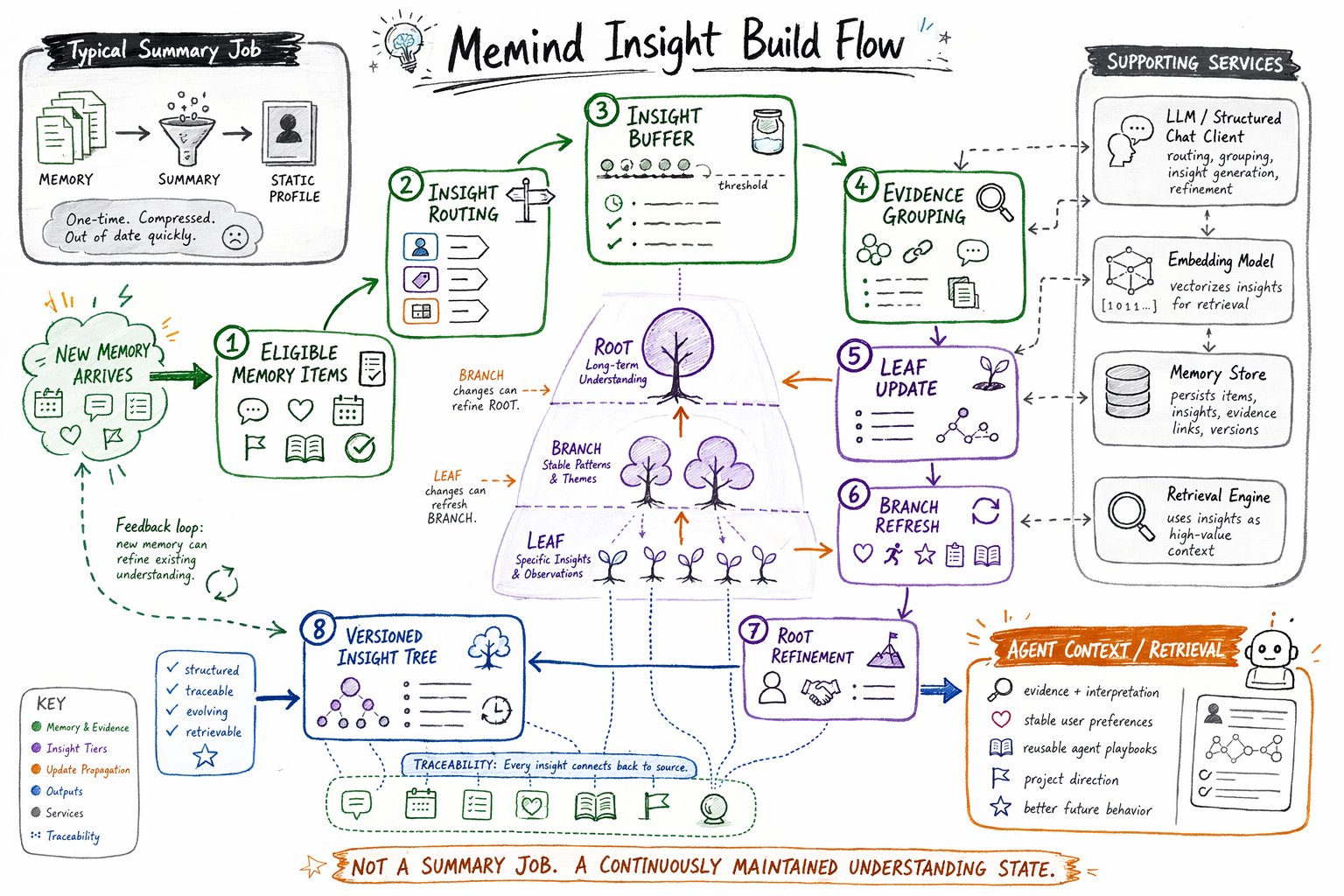
This creates a layered memory model where understanding can mature gradually.
Tree tiers
The tiers are not only presentation levels. They are update boundaries. New evidence can update a localLEAF without rewriting the whole profile. Repeated leaf-level changes can refresh a BRANCH. Only durable, broad patterns should affect a ROOT insight.
This lets Memind evolve understanding without overreacting to every new memory item or freezing old summaries forever.
LEAF insights
LEAF insights are the closest insight layer to memory items.
They capture local patterns from related evidence. A leaf insight may represent a repeated preference, a project-specific pattern, a local behavioral signal, a recurring instruction, or a resolved problem.
Leaf insights are useful because they preserve detail while reducing noise.
BRANCH insights
BRANCH insights consolidate multiple leaves within a broader dimension.
For example, several leaf insights about writing feedback, documentation structure, and implementation expectations may contribute to a broader preferences branch.
Branch insights are where local observations start becoming stable understanding.
ROOT insights
ROOT insights synthesize across branches.
They represent broad understanding, such as the user’s overall profile or the interaction model between the user and the agent.
Root insights should not be treated as arbitrary summaries. They are built from lower-level branches, which are built from leaves, which are grounded in memory items and raw evidence.
Built-in insight types
Memind includes built-in insight dimensions for both user memory and agent memory.User insight types
Agent insight types
Root insight types
These types give Memind a structured way to organize understanding instead of placing all insights into one flat bucket.
Evidence and traceability
Insight is only useful if it can be inspected. Memind keeps insights connected to the memory that produced them. An insight can include summary points, reasoning points, source item references, and source point references. This lets developers inspect:- which memory items contributed to an insight
- why an insight was generated
- whether the insight is still supported by current evidence
- how an insight changed over time
- whether retrieval should trust the insight
Updating and self-evolution
The Insight Tree evolves as memory changes. When new memory arrives, Memind does not simply append another summary. It can update the relevant leaf insight, propagate that change into branch-level understanding, and refine root-level understanding when the evidence is strong enough.How insights are used
Insights are used as high-value context during retrieval and agent context construction. Instead of returning only raw snippets or individual items, Memind can retrieve higher-level understanding when it is useful for the query.
The item provides evidence. The insight provides interpretation. Together, they let the agent work from both source memory and accumulated understanding.
Configuration
Insight behavior can be controlled through Memind runtime configuration. Most applications can start with the default insight behavior. Tune configuration when you need more control over:- whether insight construction is enabled
- which memory items can contribute to insights
- how memory accumulates before insight updates
- how leaf, branch, and root insights are refreshed
- whether insights are vectorized for retrieval
- whether insights are included in retrieval results and agent context